Special Issue #35 2027 (Call for papers: March 31, 2027. Publication: October 31, 2027)
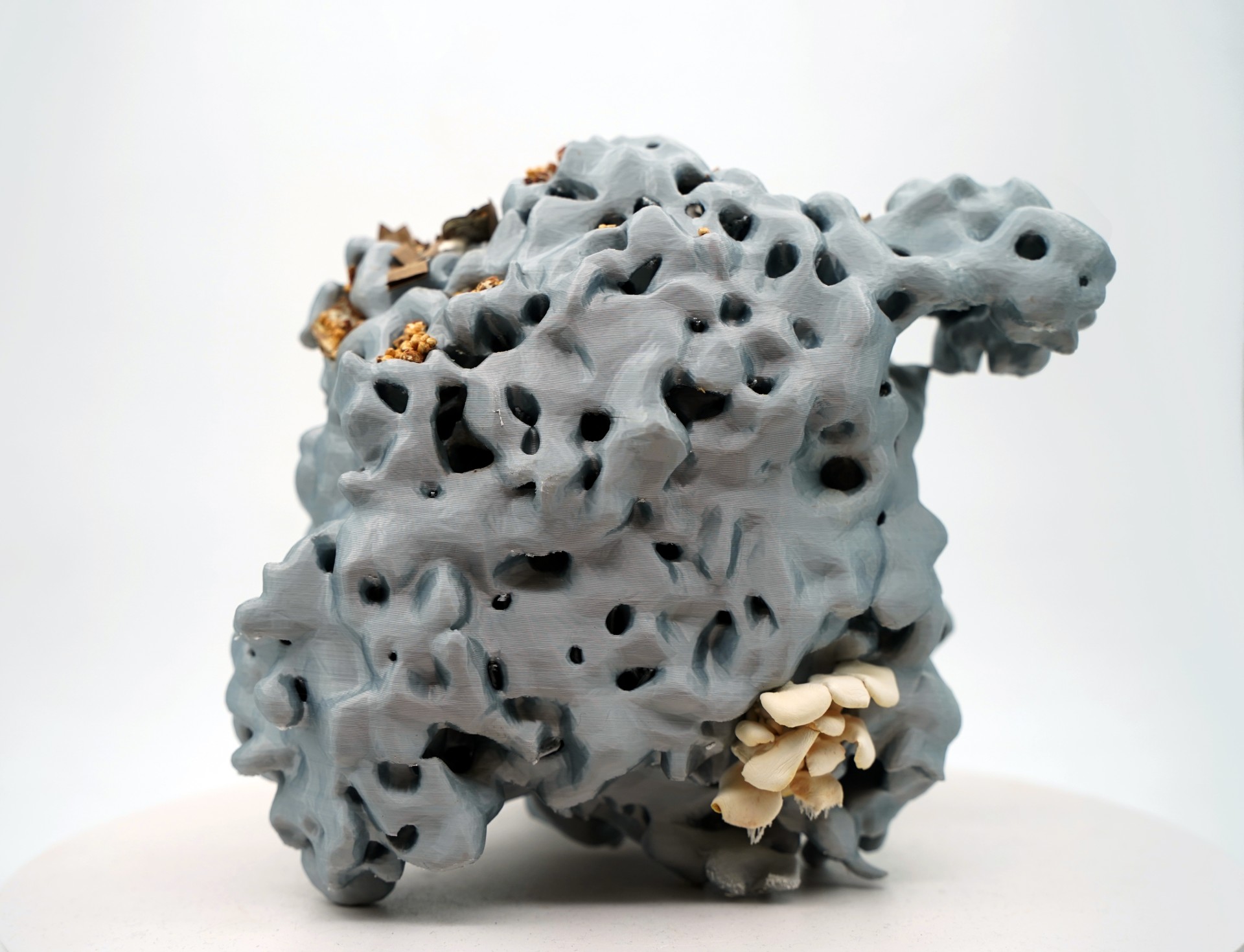
Fig: Iglesias, A. (2025) La ternura de lo vivo. Impresión 3D inoculada con Pleurotus ostreatus.
- OpenASRI · No. 35.
- Deadline: March 31, 2027.
- Publication date of the monograph: October 31, 2027.
Editors: Antía Iglesias, Ana Soler Baena, José Carlos Espinel, and Santiago Morilla. - Title: Biocreative Overflow: Matter, Consciousness, and Perception.
Abstract and Research Themes:
The special issue Biocreative Overflow: Matter, Consciousness, and Perception aims to foster a critical dialogue regarding the various ways of coexisting and relating to post-natural living entities, viewed through the lens ofcontemporary artistic-scientific research. This initiative seeks to bring together projects that advocate for the consolidation of a "third space" of knowledge production—hybrid and transdisciplinary—emerging from the intersection ofart, science, and technology (Wilson, 2010; Born & Barry, 2010). Stemming from the Art at the Edge of Nature IV event—organized by Antía Iglesias and the University of Vigo in collaboration with the Complutense University ofMadrid—this project proposes creating a written space for collective reflection. It aims to push the boundaries of academic disciplines and propose alternative ways of knowing and relating to our environment. Faced with a "hyper-object" climate crisis (Morton, 2013), we are compelled to question existing knowledge models and reflect on impending ethical and ecological transformations. We therefore invite proposals that engage with emerging fields such as contemporary bio-art, the environmental humanities, or critical ecologies, seeking to contribute to defining a field that is becoming increasingly essential at both national and international levels.
By questioning the centrality of the human subject and proposing decentralized, more-than-human models, the aim is to reframe the nature/culture dichotomy through creative practices—understood as modes that cut across thearts and sciences. The goal is to gather practices that inhabit conceptual and experimental territories, shaping spaces where alternative forms of attention and coexistence can be explored, while viewing the art-science-matterinterface as a space of contact and interaction—or "intra-action," in Baradian terms (2007).
Thus, we propose articulating an ecosystem of approaches and inquiries centered on four main axes:
- Responsibility toward matter and materials, reformulating the relationship between the aesthetic and the political. What tensions arise between caring for living matter and instrumentalizing it as an aesthetic or structuralresource? How do new materialisms allow us to rethink material agency beyond its symbolic or representational function? How do we understand authorship in shared environments? How do we understand responsibility and ethics when working with living organisms?
- The role and potential of technoscientific mediation in fostering expanded modes of perception, while questioning its limitations and underlying premises. What forms of perception do contemporary technologies enable—and which do they block or distort? Can technoscientific mediation generate forms of attention toward the non-human that would be impossible to the naked eye? Or does it inevitably translate them into human terms? What epistemological limits does technology reveal when used as a perceptual prosthesis for engaging with the living world?
- Practices of interspecies cohabitation, drawing on multispecies studies and modes of existence constituted from a non-anthropocentric perspective. What forms of conviviality, collaboration, or coexistence are possible between an artist-researcher and a non-human organism within the framework of a biocreative project? How are consent, agency, or resistance negotiated or acknowledged? What do we learn about our own categories of "life," "species," or "individual" when attempting to cohabit—temporally or spatially—with another species? What practices of care or harm emerge during cohabitation in laboratory, studio, or exhibition settings?
- Disciplinary overflows that allow for the imagining of new hybrid methodologies—understood as shared working protocols—capable of generating forms of knowledge that neither art nor science would produce in isolation. How is a research process documented, evaluated, or legitimized when it fits neither the traditional methodological criteria of art nor those of science? What role do error, experimental failure, or the unforeseen play as legitimate parts of the method in these hybrid practices? What new forms of authorship or collaboration (interdisciplinary, inter-institutional, interspecies) should emerge from these overflows?
The various facets of this ecosystem—interrelated and potentially complementary—will enable the mapping of projects and practices that, together, propose post-anthropocentric ways of being and existing alongside other entities, demonstrating the suitability and necessity of biocreative environments for conscious research and existence.