EXTENSION Call for Contributions. Special Issue #31 2026 (Call for Papers: June 30, 2026. Publication date of the monograph: October 31, 2026)
-
OpenASRI · Issue 31 (2026)
-
Deadline: 30 June 2026.
- Publication date of the monograph: October 31, 2026.
-
Editors: Andrés Pachón and Luís Quintais.
The agency of images in the cognitive ecology of artificial intelligence
Images possess a ‘generative force’ (Bredekamp, 2010) that makes them act upon us, not only by mobilising us to action—something we found in propaganda or iconoclasm—but also by provoking new ways of acting whose ultimate goal is to transform experiences and events into images, as evidenced in such radically opposed phenomena as tourism and terrorist acts (García Varas and Martínez Luna, 2022). Images operate as agents with their own entity and not merely as mediators of human intentionality, which finds its maximum expression in autonomous images: visual entities that are not directed at human perception, but operate within automated systems of analysis, decision-making and algorithmic intervention, reconfiguring the traditional relationships between author, image and observer. These operative images (Parikka, 2025) raise ethical and political questions about responsibility, opacity and the exploitation of resources.
Here we find an update of the anthropological debate on what we understand by persons and artefacts. As anthropological literature has shown from early on, the concept of person is not reserved exclusively for human beings, but can also be applied to animal and plant species—as confirmed by the debate on totemism (Ingold, 2000; Rosa, 2002)—as well as to technical objects and cultural artefacts. Along these lines, Brad Shore (1996) coined the term techno-totemism to describe an industrial and post-industrial version of the human/non-human hybrids already present in pre-industrial cultures. It could therefore be said that one of the ways in which agency and intentionality are attributed is linked to the way in which artefacts and technologies are presented, in the midst of modernity, as entities with their own designs, which escape human control, thus becoming unpredictable.
In the cognitive ecology of artificial intelligence (AI), the ontological distinction between people and artefacts appears more blurred today than ever before. This makes the question of the agency of images a cross-cutting issue for both the phenomenon of AI and contemporary artistic practice. To a large extent, this is a response to technical advances in generative artificial intelligence (GenAI) and the automation of creativity, processes that challenge the capacity for human agency. Furthermore, technology companies will use creativity as a pretext (Steyerl, 2025) to extol the agency capabilities of AI: the aesthetic and photorealistic quality of images produced using GenAI is presented as proof of the supposed creative and cognitive capabilities of AI systems. A paradigmatic example is promptography: images produced through text descriptions (prompts) and AI systems such as Midjourney, Stable Diffusion, or DALL·E. From the perspective of agency, photorealistic promptography is particularly relevant, as it represents the world mimically without the need for a photographer, camera, or direct real-world reference. Unlike photographs, these images no longer represent the present for us to see and think about the past, but rather rewrite history and represent the future (Ritchin, 2025), actively participating in the production of cultural memory, historical imagination, and the projection of possible futures. This makes them a powerful tool that threatens to reformulate and render the past invisible, while projecting futures that influence public opinion.
This monograph aims to analyse the mechanisms by which we attribute agency and intentionality to images, artistic artefacts and AI systems, to the point of destabilising the ontological categories of people and objects. Its objective is to understand how the massive implementation of GenAI has transformed the agency of images and reformulated our cognitive ecology and contemporary processes of visual production and circulation.
Despite these transformations, artistic artefacts continue to function as artefacts of resistance to the discourse of the automation of creativity and human intelligence. According to Alfred Gell's anthropology of art (1998, 1999), standing in front of a work of art is like standing in front of someone; the artistic artefact generates a situation of co-presence and does so precisely because it activates a complex network of intentionalities that are polarised around agents (artists), patients (viewers) and indices (images/artefacts). While GenAI images reduce the creative process to a set of recognisable and marketable styles based on repeatable visual patterns (Meyer, 2023), art images can account for the social agency (Gell, 1998; Latour, 1999) involved in the creative process, without ceasing to affect us and act upon us.
The volume invites academics and visual artists, at any stage of their career, to contribute research and practices that explore the epistemic and ontological relationships and differences between the agency of AI-generated images and the agency of art images, as well as the role of artistic practice in critiquing and visualising the socio-technological conditions of visual culture in the age of GenAI.
TOPICS FOR SUBMISSIONS
Contributions may address, among others, the following themes:
-
- Artistic and curatorial practices as resistance to the automatism of creativity and the myth of AI's autonomous agency.
- Agency and intentionality of images generated by AI.
-
Agency of artistic work in the age of AI.
-
Promptography and algorithmic photorealism as devices for the cultural and creative legitimisation of AI.
-
Autonomous images, operative images, automation, and politics of vision.
-
Cultural memory, heritage, and historical imagination in the age of AI.
-
Artistic and curatorial practices as resistance to the automatism of creativity and the myth of the autonomous agency of AI.
ARTICLES
Articles must follow the IMRyD academic format: introduction, methodology, results and discussion or conclusions, followed by bibliographical references.
Articles must comply with APA 7 standards.
SUBMITTING PROPOSALS
Submissions must be made through the submissions section, preferably in Word (or txt) format, following the Author Template and the rest of the journal's guidelines.
https://revistaasri.com/about/submissions
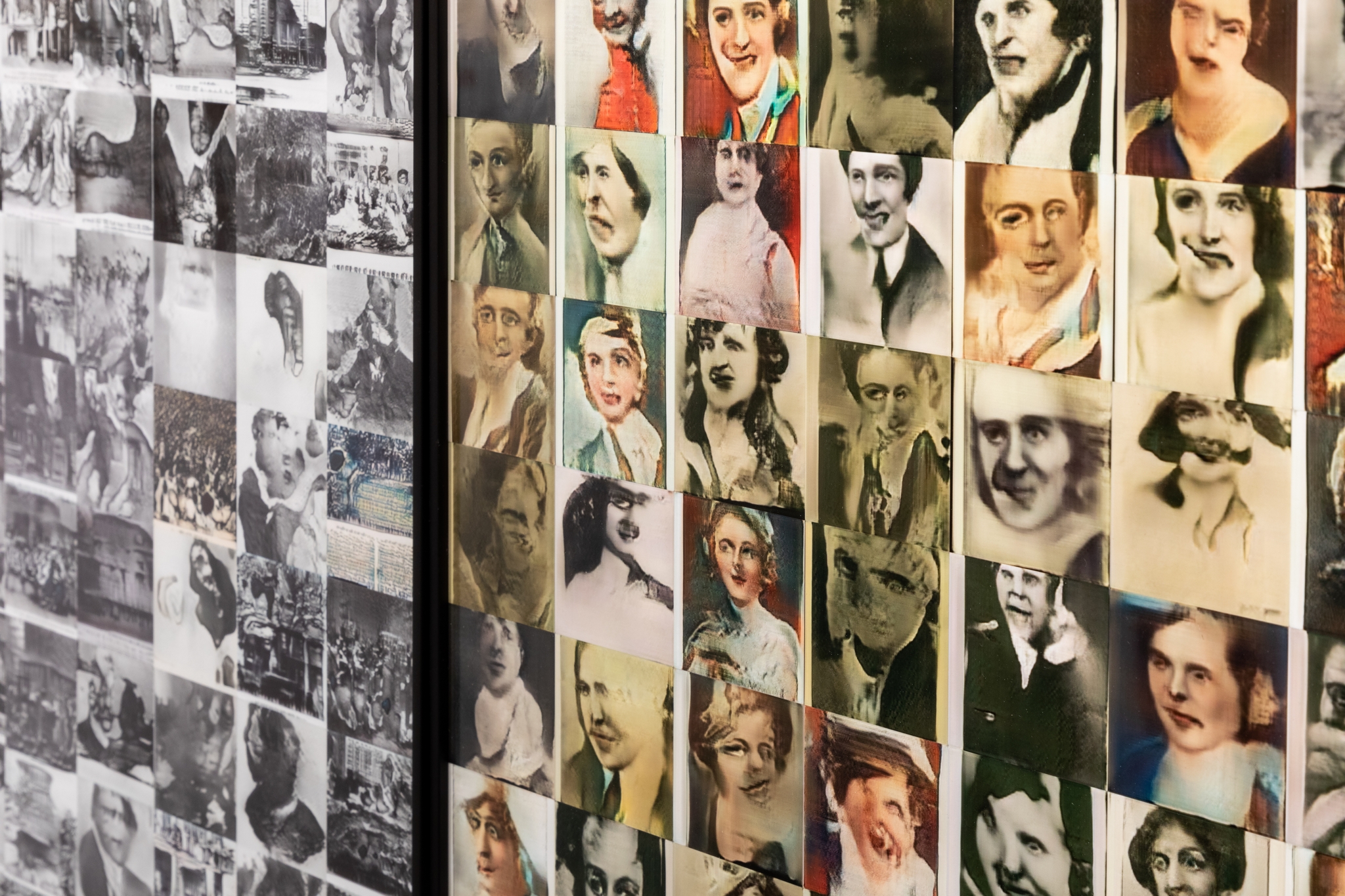 Andrés Pachón, "Class(H)" (Vista Parcial De La Instalación), 2021