








ISSN: 2174-7563

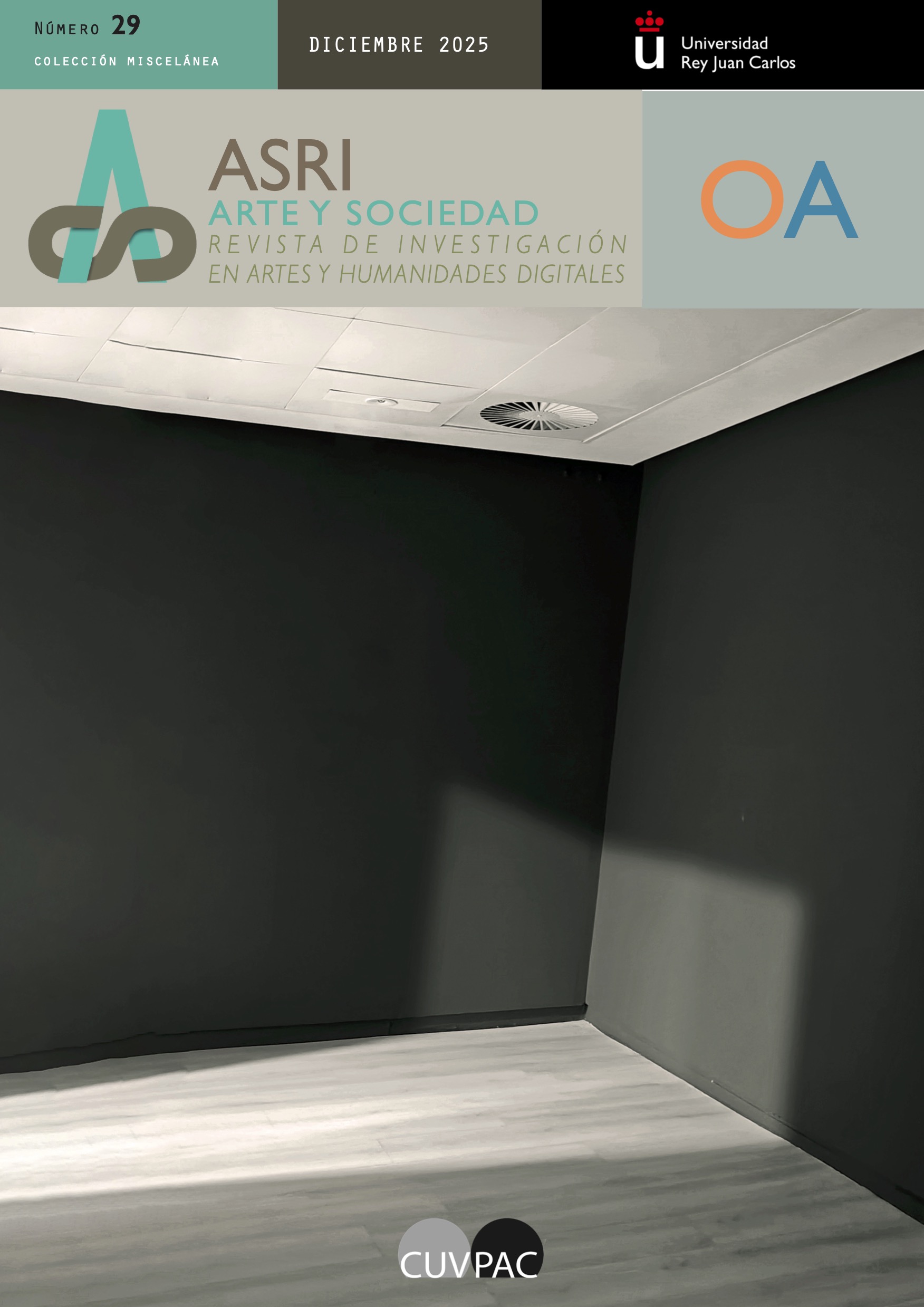
The end of the year invites us to reflect on the role of art and digital humanities within a context shaped by technological acceleration, cultural transformation, and the need to rethink our ways of relating to image, body, and memory. This new miscellaneous issue of ASRI. Art and Society is conceived as an open space for interdisciplinary dialogue, where artistic practices, critical thought, and theoretical explorations converge to interrogate the boundaries between the material and the virtual, the human and the posthuman, the individual and the collective.
Posthumanist narrative emerges as a critical response to the fusion of organism and machine, questioning the centrality of the subject and proposing imaginaries where the biological and the technological intertwine in hybrid architectures and discourses that explore the contemporary condition through existential absurdism and scientific determinism. At the same time, the coexistence of traditional techniques and digital tools redefines creative processes, generating hybrid methodologies that not only expand formal possibilities but also open debates on authorship, sustainability, and memory in artistic production.
In this context, art becomes a space for dissent and critical reinterpretation of identities. Queer aesthetics strain the boundaries between gender, desire, and representation, proposing affective cartographies that make historically marginalised corporealities visible and challenge normative narratives through performativity and the politics of the image. These practices do not develop in isolation: hyperconnectivity and the role of social networks as instruments of collective action transform the way cultural critique is exercised, consolidating platforms that function as spaces of resistance against institutional censorship and as stages for the construction of alternative discourses.
With these perspectives, ASRI reaffirms its commitment to critical research and interdisciplinary creation, offering an open territory to think about how art and technology shape our ways of life, our memories, and our possible futures. We invite the reader to explore these pages as a space for reflection and experimentation within the digital society.
Editors: Miguel Ángel Rego Robles and Andrea de la Rubia Gómez-Morán
ISSN: 2174-7563
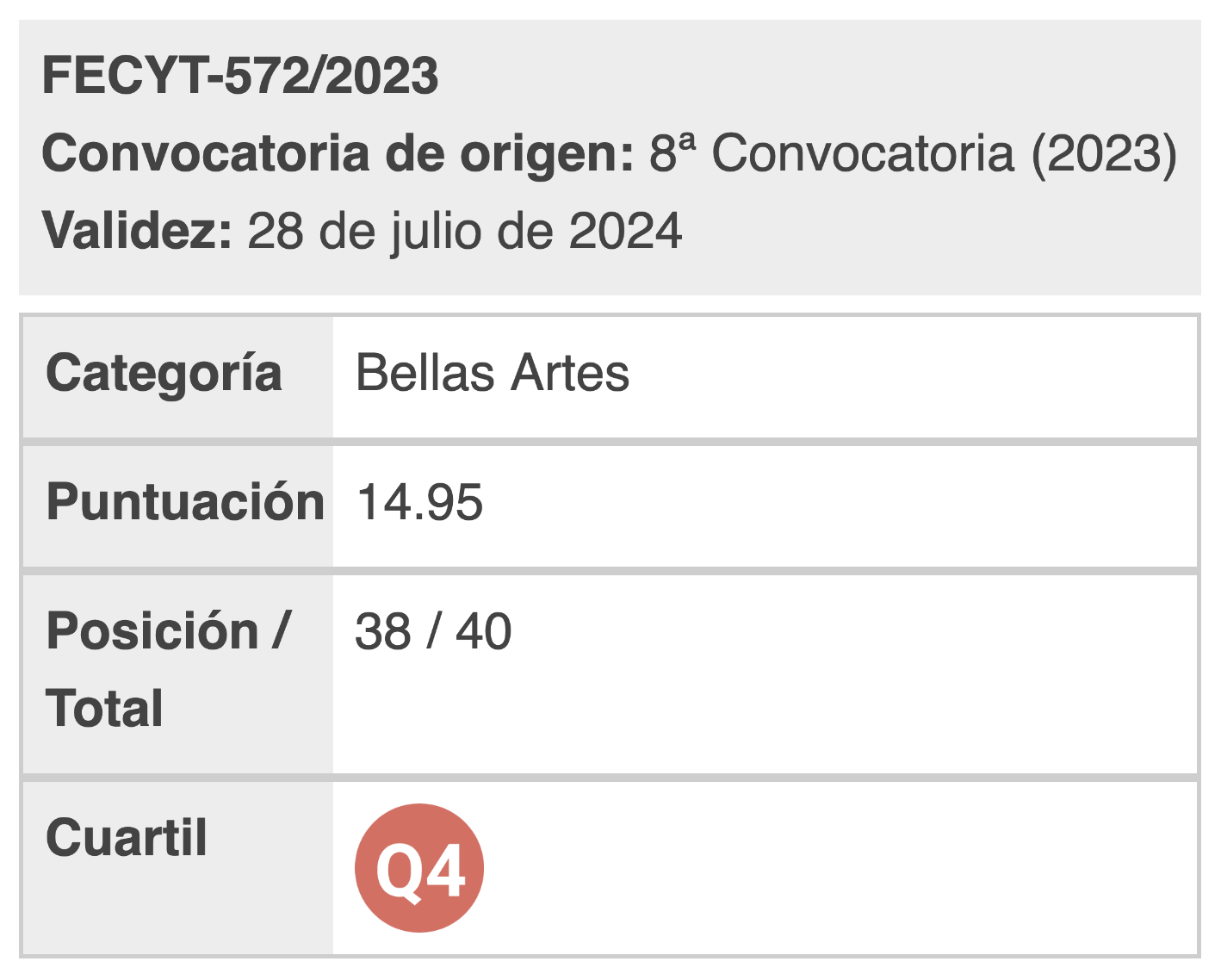












ASRI. Art and Society. Research journal in Art and Digital Humanities. ISSN: 2174-7563, edited by the Publications Service of the Rey Juan Carlos University.
It is an online publication coordinated by the CUVPAC research group of Rey Juan Carlos University, and It is open access, free, and entirely free for readers and authors. The magazine does not require a subscription fee, nor does it require any payment from the authors to publish and access the content.

This work is licensed under a Creative Commons Attribution 4.0 International License. Creative Commons Attribution 4.0 International License.

The contents may be read and used, copied, distributed, transmitted, publicly displayed or transformed, provided that they comply with the following terms:
Authors are encouraged and allowed to spread the contents of the journal on their social networks and electronic publications (with their logos, pagination, an indication of the volume and number of the journal, ISSN, included), to favor its circulation and dissemination and with this, a possible increase in its citation and reach among the academic community.
Publications Service of the Rey Juan Carlos University. Paseo de Artilleros, s/nº, 28032 MADRID (Spain)